
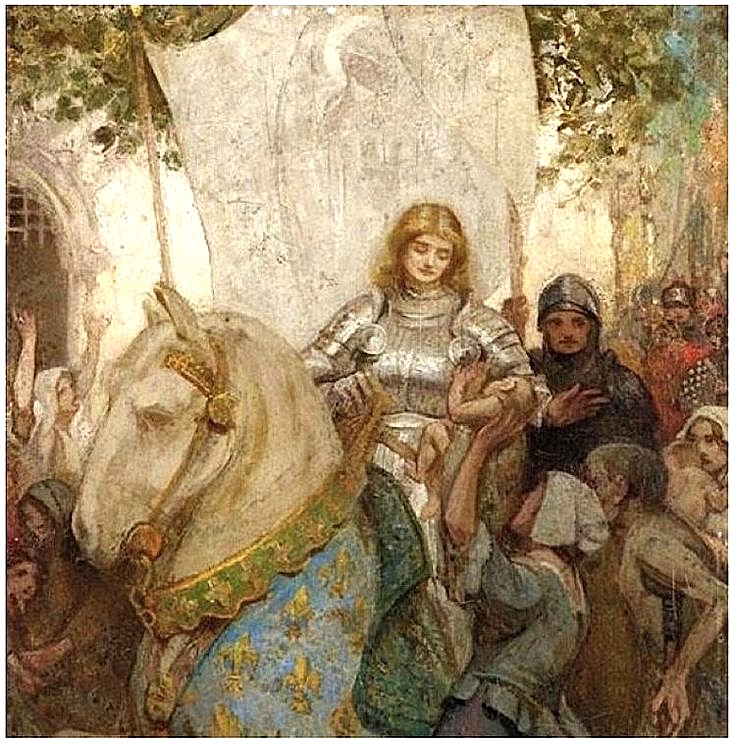
May God grant us the same courage and femininity that He endowed Jeanne d’Arc with!
Within and outside the Catholic Church, St. Joan of Arc is universally revered as one of the most prominent figures in the history of France, both politically and religiously. As a young maid of 17 years, she began her mission to save France from siege by the English after being sent by those she called ‘her voices’. We now know that among these voices were those of St. Michael the Archangel, St. Catherine of Alexandria, and St. Margaret of Antioch. She eventually led the French army to victory throughout the couple of years that followed. Despite how chivalrous she was, she remains an icon of femininity, especially to women who, perhaps, happen to find themselves in unfeminine roles or tasks. Like the Biblical Judith, Joan of Arc was a most unlikely but perfect choice of God to bring victory to His people, while preserving her innocent womanliness.
Who was Joan of Arc -really?

As a brief background, she was the daughter of a tenant farmer at the village of Domrémy-la-Pucelle, in northeastern France. She lived a peasant girl’s life before she was called to embark on the mission that had been divinely set out for her.
However, contrary to popular opinion, Joan of Arc was not the type of woman you would see on shows like ‘Damsel’. She was not a Mulan. She was not the stereotypical boss woman that ‘wanted to fulfil her destiny by forgoing sexist roles in the village and joining the army to defy the norm’…
Joan of Arc was a saint. Therefore, she was humble. In fact, because she was hesitant about her calling, it took her about four years to adhere to the command of ‘her voices’ and seek means to lead the French army to victory. Even as a warrior, after she had made a name for herself (i.e. ‘the maid’), she always sought to return home and as she said, ‘remain spinning wool at her mother’s side’. But she decided to do what God willed for her.
Apart from the victories on the battlegrounds, it is said that Joan of Arc made spiritual victories in the souls of the soldiers whom she led. She inspired in them a drive to fight chivalrously for France and to be virtuous. The soldiers’ camp must have been riddled with vices of blasphemy, drunkenness, and promiscuity, but her leadership called everyone to order and encouraged them to be saints.
So, she simply was not a feminist. Joan of Arc did not cut her hair or wear manly dress because she believed in female empowerment. On the contrary, the maid changed her attire to preserve her modesty, knowing that she would be living amongst grown men. She never took her armour off -not even to sleep- and perhaps, she thought that if she looked like a man, the natural attraction of the soldiers to her womanly frame would be diminished. And it was. To hers, the soldiers’, and the nation’s good.
Lessons from ‘The Maid’

I had never really thought that a woman could be feminine and inspire men, even while in normally masculine roles. Not till I had looked at the life of St. Joan of Arc (and that of her Old Testament counterpart, Judith).
From the life of St. Joan, there is one big message we all can learn as women: Womanhood is what it is, despite your walk of life or calling. There is no excuse to behave like a man, even when your vocation causes you to be surrounded by them. In the end, the big lesson is one of virtue. And virtue can never be opposed to the nature of a thing.
Therefore, what are the two minor lessons we can learn from The Maid for practical living as women?
One: Femininity does not mean timidness.

There is a difference between innocent daintiness and timidness. A woman can be dainty or childlike without letting go of her courage or decisiveness. One of the most common descriptions of St. Joan’s demeanour was innocence and modesty. Yet, this did not waver her courage in answering her call to battle, leading the French army for years, and afterwards, during the unjust trial that preceded her death, refusing to deny the credibility of the voices that had commissioned her to lead the army. Every act of courage she exercised was done with sweetness, childlikeness, and femininity, which inspired the good and convicted the wicked in their hearts.
So, have you been coaxed by the modern society, which is only obsessed with the superficial, to think that femininity is just a synonym for shyness and dim-wittedness? Unlearn it!
Honestly, I think that the most intelligent women are those who are so in-tune with their womanly nature that they can change and inspire the world around them by just being.
And by being, I mean being virtuous. Again, virtue never conflicts with your nature. It is virtuous to be feminine because you are a woman.
If that is so…
Two: Femininity should not be thrown away under the guise of fitting into masculine roles.

Imagine what would’ve happened if St. Joan had walked into the soldiers’ camp and joined them in their debauchery, in the name of ‘fitting in’. Her mission would’ve been nullified before it would’ve even begun. Perhaps, there is a reason that God sent a young, innocent girl like her to lead those men: It is because femininity and childlikeness are the two big attributes that can change, not only men, but the world. If she had come in like a brute, getting drunk and ordering everyone around like a war general, the men would’ve taken her to be just ‘one of the guys’ and the gravity of her leadership would’ve been diminished.
But the contrary behaviour is something that our current society has ceased to understand: Virtuous womanhood brings men and the world to order, and it does so in a coaxing way, so that what seems arduous (e.g. Going to war, abstaining from vice, etc.) becomes a sweet and worthy thing to do, to preserve that virtuous womanhood.
Let me put it in other terms: Femininity is so powerful that it can bring men to virtue, without the need of external force. And when it does bring men to virtue, virtuous men will work hard to preserve femininity. You may have heard adages like ‘femininity inspires masculinity’, and I would add that ‘masculinity preserves femininity’.
What better way could it have been shown than by the warrior life of Joan of Arc? She did not lead those men to battle by force or masculine strength. She inspired them to virtue and chivalry by simply being herself -by being feminine. And in return, those soldiers found it sweet to fight for her and for France.
I think we can all take a leaf from her book. This is especially true for women who may find themselves in vocations or work that is particularly masculine. Whether it is working on a construction site or shouldering the bread-winning role of the family due to unforeseen circumstances, there is enough space for femininity to thrive and change the world around you.
I am not saying that you have to be an endearing, flowery girl who wears pink dresses and sings all day. Not every woman has that personality. However, embedded in the nature of every woman is the essence of femininity. And since virtue does not contradict nature, the more virtuous you become as a woman, the more feminine you will be, and you wouldn’t even have to try.
In conclusion,
St. Joan of Arc definitely did not have to try -to be feminine. It is precisely because of her heroic practice of courage in faith, while preserving her modesty and femininity, that she triumphed in the end and is recognized as a figure of emulation inside and outside of the Catholic Church. It was an honour to learn about her, and it would be a greater honour to meet her, hopefully, in the World Beyond. In this society, polluted with feminism, it is such a refreshment to see a woman ‘run the world’ with her simplicity and pure womanhood.
Now, it’s your turn. Did you know of St. Joan of Arc? What about her life as a female warrior inspires you? I would love to know!

Au revoir,
Christine.





Leave a Reply