
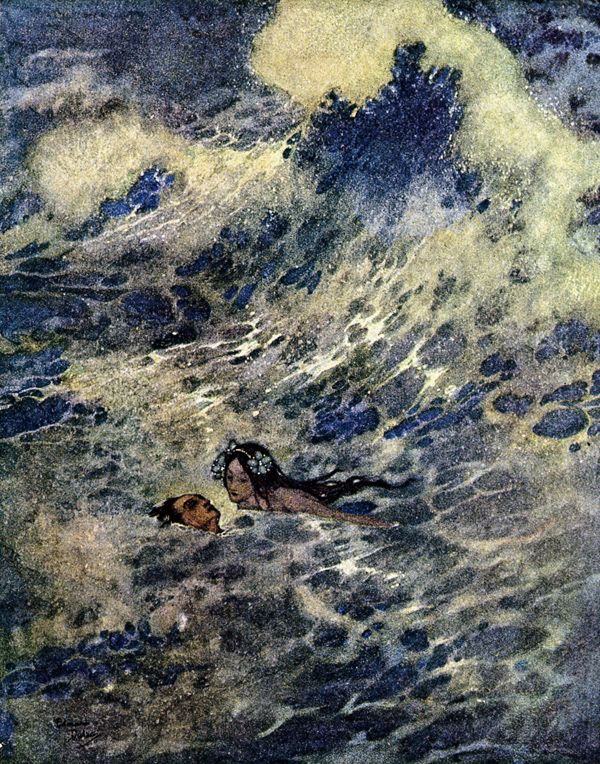
Before I begin, my verdict is: Disney should have stuck to this script…
Recently, I’ve been going through some fairy tales (specifically, the Grimm Brothers’ tales) and have been contrasting them with their versions portrayed by Walt Disney. As it has already been noted by others, the original versions of the Grimm Brothers’ tales were far more hideous than their Disney counterparts, and though I do not want to get into the reasons (valuable, they are) why Disney may have watered down those gruesome stories, there is one thing to note: In all those adaptations, the moral story remained clear.
I’m not sure I could say the same for The Little Mermaid, however. As opposed to the other tales (Cinderella, Beauty and the Beast, Rapunzel, Sleeping Beauty, etc.), The Little Mermaid was not written by the Grimm brothers, and therefore, lacked the overt atrociousness that is usually the hallmark of the Grimm fairy tales.
That being discovered, I had convinced a good friend of mine, Hannah, to undergo the experiment of comparing The Little Mermaid, as adapted by Disney, with the original story. This has already been done countless times by other people; however, after having discussed it, we came to a lot of conclusions about some solid Catholic moral lessons that the original story had.

The final summary was that in this case, the Disney story would’ve been better off sticking to the script.
The Little Mermaid, authored by Hans Christian Andersen, is what I’ve learned to call a serious story. A fairy tale, yes, but not without the portrayal of the common human condition and the consequences of virtue and vice. These are moral elements that make a fairy tale worthwhile in the first place and make it valuable, not only for children but for adults, to read.
The Real Story.

It would waste ink to write out the whole story of The Little Mermaid in this post. But as a short synopsis:
It tells of the youngest mermaid princess in a family of six mermaid princesses, who, after venturing to see the land above the sea, where she lived, becomes enamoured and obsessed with a prince. After saving the prince from a shipwreck and employing means to watch him, day and night, her love for him pushes her to obtain an unfair deal from the sea witch, who grants her legs (in exchange for her voice) that she may live on land and by chance, win the prince’s heart. The witch enacts that if the prince falls in love with another, the little mermaid’s heart will break on the morning after the wedding, and that she will become like the foam of the sea waves (in mermaid terms, she will die).
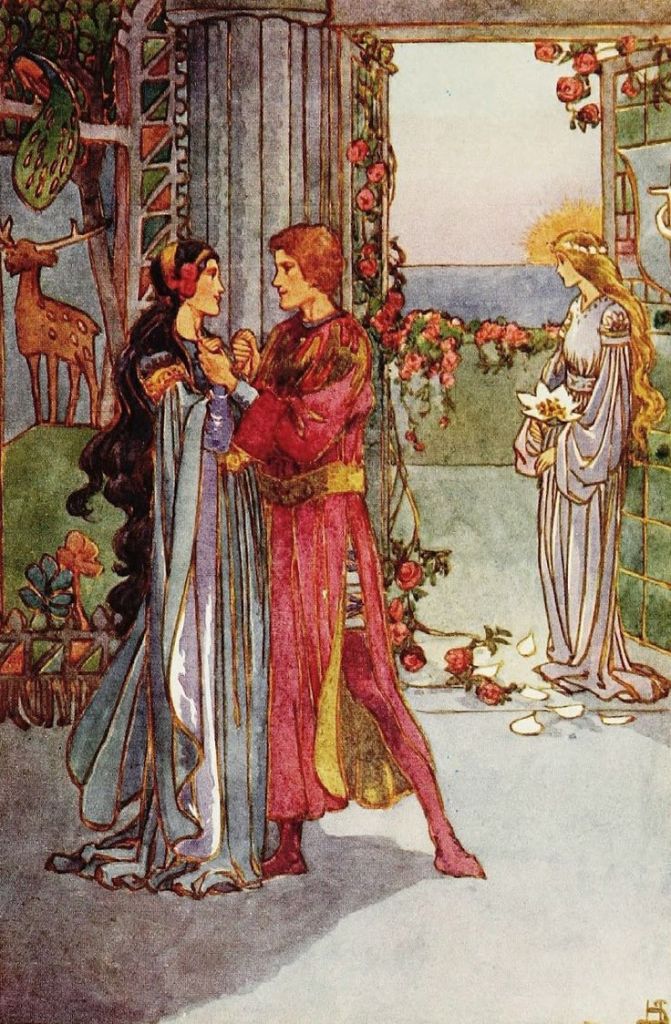
Unfortunately, the mermaid accepts the terms of the deal, exchanges her voice for legs, and ventures onto land. However, the prince, at first being enchanted by the little mermaid, falls in love with a princess from another kingdom and makes her his bride. At this, the little mermaid grows sorrowful and prepares for her death the next morning. As the dawn approaches, her five sisters appear on the waves with their long tresses cut off by the witch’s scissors. They tell the little mermaid that they have sold their hair for a knife, which she can use to stab the prince in the heart and obtain her mermaid fins back.
A moment of choice appears as the little mermaid takes the knife and goes into the tent where the prince is sleeping with his bride. But scarcely does she look at him when she throws the knife away and jumps into the sea, accepting her fate. However, having exercised this moment of heroic virtue, she is transformed into a spirit that cannot die, but will roam the earth, bringing about good, for three hundred years, after which she can then obtain an immortal soul (like that of humans), and as it was written, “float into the kingdom of heaven”.
The tale is more whimsically told by Andersen, but this is just a summary…
The Catholic Morality of the Story
The moral of the story is evident.
Firstly, there is a clear distinction between the true, the good, and the beautiful, and the fallacious, the bad, and the ugly. Andersen makes it clear in the way he draws a line while describing the palace of the sea king, nature, and Christian civilization; and the domain of the sea witch, subversion of beauty, and hedonic civilization. He does not mix them both in the name of ‘sympathizing with the devil’ or justifying evil means with a good end. Instead, he uses words to paint an architecture that inspires a love for good and a contempt for evil:
The good Kingdom:
Far out in the ocean, where the water is as blue as the prettiest cornflower, and as clear as crystal… There dwelt a Sea King…[The Sea King’s castle] walls are built of coral, and the long, gothic windows are of the clearest amber. The roof is formed of shells that open and close as the water flows over them. Their appearance is very beautiful, for in each lies a glittering pearl, which would be fit for the diadem of a queen… All day long, they [his daughters] played in the great halls of the castle or among the living flowers that grew out of the walls. The large amber windows were open, and the fish swam in, just as the swallows fly into our houses when we open the windows, except that the fish swam up to the princesses, ate out of their hands, and allowed themselves to be stroked…
The Witch’s Kingdom:
…Neither flowers nor grass grew there; nothing but bare, gray, sandy ground stretched out to the whirlpool, where the water, like foaming mill-wheels, whirled round everything that it seized, and cast it into the fathomless deep… The only road lay right across a quantity of warm, bubbling mire… A space of marshy ground in the wood, where large, fat water-snakes were rolling in the mire, and showing their ugly, drab-colored bodies. In the midst of this spot stood a house, built with the bones of shipwrecked human beings. There sat the sea witch, allowing a toad to eat from her mouth… She called the ugly water-snakes her little chickens, and allowed them to crawl all over her bosom.
I cannot say more on this. The excerpt above says it all. However, it leads me to my next point of conversation.
Authority
Authority is the hallmark of an orderly society. Beauty can only exist where there is order. It only thrives where order is protected. Andersen shows this very well as he depicts the free living of the beauty of nature (on land and within the sea), and the thriving of the mermaid princesses under their father’s orderly rule. In fact, things begin to go backward when the little mermaid turns her allegiance to the sea witch -a picture of rebellion to order.
Men and women have their roles, and neither is less important than the other. Without the protection and sacrificial leadership of men, there is chaos, in which one cannot even live. To the same degree, without the nurturing nature and beauty of women, order becomes a dystopia. Are these lines set in stone? Not necessarily. For some reasons, the lines can be blurred, but I do believe in the importance of these roles.
I think Andersen believed it too. He painted a perfect picture of the comeliness of creation and human relations, thriving under the orderliness of Christian civilization.
Family

Yes, another hallmark of beauty: Family. Community.
The mermaid princesses, having no mother, had a grandmother who took care of them and told them stories of the land above the sea. Not only did she provide motherly care, but she also gave the mermaid princesses (especially, the little mermaid) good pieces of advice to heed. The little mermaid had what many women of our day, sadly, do not have: Wise guidance and upbringing.
The little mermaid also flourished among her community, which includes the kingdom as a whole. But more importantly, her sisters, to whom she had confided the angst of her heart after saving the prince and wishing to see him again. Unlike it is today, the expression of her femininity wasn’t shooed away by voices telling her how useless and childish it was. In fact, the only time she didn’t seek the wisdom of her grandmother, or the comfort of her sisters, was after deciding she would defy her protection and go into the domain of the sea witch, who was happy to give her false hope in exchange for the tokens of her beauty and innocence.
It pains me to think that women are now doing this today: leaving the generational wisdom of their grandparents and ancestors for the momentary pleasure of listening to modern women, many of whom do not have their best interests at heart.
The Reality of the Eternal Soul, and the Impact of Vice and Virtue on it
“Why have not we an immortal soul?” asked the little mermaid mournfully; “I would give gladly all the hundreds of years that I have to live, to be a human being only for one day, and to have the hope of knowing the happiness of that glorious world above the stars.”
Unfortunately, we human beings cannot be grateful for what we have. We were given an immortal soul by God, only so that we can know the joys and glories of paradise forever. But why do we live as if we had no immortal soul? We live without faith, hope, and charity. We are ashamed of good and of beauty. That which is vile is praised, and that which is beautiful is downplayed.
You never know what you have until you lose it. So endeavour to save your soul, not to lose it.
The Reality of the Bond of Marriage
“No,” said the old woman [the little mermaid’s grandmother], “unless a man were to love you so much that you were more to him than his father or mother; and if all his thoughts and all his love were fixed upon you, and the priest placed his right hand in yours, and he promised to be true to you here and hereafter, then his soul would glide into your body and you would obtain a share in the future happiness of mankind. He would give a soul to you and retain his own as well…”
If people knew this, divorce would be extinct: Love gives and is never exhausted. Love fights for the ultimate good of the beloved. I would never let a man put a ring on my finger if I sensed that he did not understand this. And the same would apply for me if I couldn’t have this sort of love for him.
Because once sealed, the bond will always be sealed. The little mermaid understood this. Perhaps that is why she refused to kill the prince and rob his wife of his love. She loved the prince, even if it meant letting him love another.
Here’s a question for thought: Even if you end up getting your prince, could you love him this way?
Finally, what may the little mermaid have wanted?

Everlasting happiness and joy.
That’s all she wanted in the love of the prince -the eternal love that would seem to emanate from his soul to hers. However, would he have been able to give her this eternal love? Can your spouse, betrothed, or any created thing give you that degree of love you seek?
In the end, she did not get the prince, but the little mermaid lived happily ever after, because of the certainty that she would one day attain a soul and “float into the kingdom of heaven”. For us, we have a soul. What is left is to place our treasure in the same destiny.
With the hope of paradise…
So what now?
I have already given the conclusive moral lesson, but as a final word, the only thing I can say is:
Read more fairy tales. Do not think you are too old for them. It’s surprising how much of life I’ve thought about by reading a good old folktale -the original way.
” Some day, you will be old enough to start reading fairytales again.” -C.S. Lewis.
And you? Have you read Hans Christian Andersen’s The Little Mermaid? What Catholic teachings, feminine principles or virtues did you learn from it? Can’t wait to hear!

Au revoir,
Christine.






 DREAMS OF TOMORROW
Leave a Reply